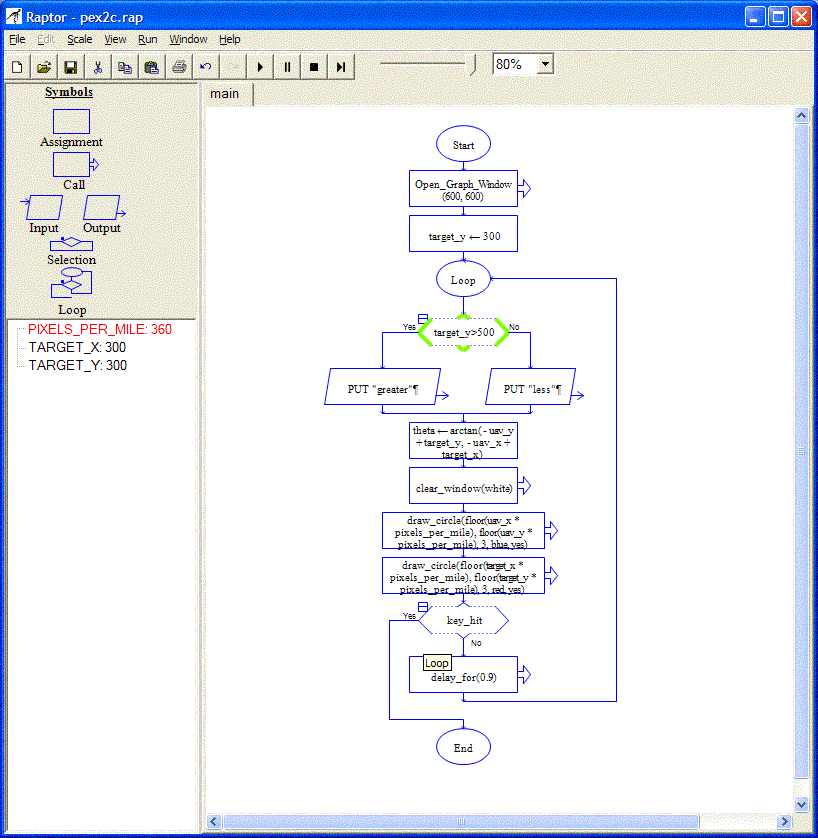
RAPTOR is a flowchart-based programming environment, designed specifically to help students visualize their algorithms and avoid syntactic baggage. RAPTOR programs are created visually and executed visually by tracing the execution through the flowchart. Required syntax is kept to a minimum. Students prefer using flowcharts to express their algorithms, and are more successful creating algorithms using RAPTOR than using a traditional language or writing flowcharts without RAPTOR.
RAPTOR Web Edition (PREVIEW!)
Are you interested in running RAPTOR on Chromebooks, iPads, or just in a browser? Check out the pre-releasehere!. This is NOT fully tested. Send feedback via
RAPTOR Avalonia Edition (Multiplatform)
A Multiplatform version of RAPTOR is now available for Windows, Mac and Linux built on top of [Avalonia]!
See the downloads section below. Uses fonts from Noto Sans CJK for internationalization.
Key differences:
Only Intermediate mode (subcharts and procedures, no OO)
Will be able to load some files from Windows-only RAPTOR, but Windows-only will not load files from RAPTOR Multiplatform
Documentation will be [online] instead of distributed with the app.
RAPTOR image and Papers
Figure 1 RAPTOR for Windows
Figure 2 RAPTOR Avalonia
Papers on RAPTOR application:
The use of RAPTOR in a general education course [view or download]
Global Chinese Conference on Computers in Education (GCCCE) 2011 [view or download]
Queries like this demonstrate the importance of digital media literacy. Audiences frequently struggle to differentiate between authentic, unscripted videos and highly produced commercial media that mimics real-life scenarios. Understanding that these scenarios are professional workplaces protects consumers from misinterpreting performance as real-world social norms. Taboo as Entertainment
If you were looking for information on different "Dancing Bear" stories, here are a few other notable works: The Dancing Bear
There is also an element of digital archivism driving these searches. The early 2000s adult internet was vastly different from today's landscape, which is dominated by a few massive streaming monopolies and creator-centric platforms like OnlyFans.
A Masterpiece of Bad Taste or Just Tasteless? Rating: ★★★☆☆ (3/5 – “Compulsively watchable, deeply unsettling”)
: It references the era when bears were forced to dance at fairs, serving as a "haunting reminder" of a time when ethics were secondary to entertainment. Reception and Impact
The "Dancing Bear" in this context most likely refers to a powerful genetic line in modern cannabis breeding. While some original "Dancing Bear" strains are less common, the name is a cornerstone for some of today's most celebrated hybrids.
Just as the Bear’s fingers brushed the cold gem, the music cut. A voice over the speakers whispered: "Welcome to the final act."
: Emphasis on "moral corruption" themes, often involving power dynamics or extreme party environments. Key Elements of Volume 25 The Milestone Production
At its core, this phrase refers to a specific, curated, and restricted-access collection of digital content—often video or image-based—that has gained notoriety for its, according to critics, ethically questionable or morally compromising subject matter.
by Michael Morpurgo : A story about a village that becomes famous for its honey after an orphaned girl adopts a bear cub. The peace is eventually disrupted by a film company [31]. Touching Spirit Bear
Rumored for years in the darkest corners of Reddit and Telegram channels named after dead drops, the “Dancing Bear 25” exclusive is allegedly the master reel—the uncut, unredacted, and unrepentant 25th anniversary compilation. But it doesn’t just contain the outtakes. According to a source who claims to have seen three minutes of it (and subsequently scrubbed their entire digital footprint), the exclusive includes:
The impact of the Dancing Bear's morally corrupt activities was not limited to those directly involved. The club's influence extended into the wider community, contributing to a culture of objectification and exploitation.
Queries like this demonstrate the importance of digital media literacy. Audiences frequently struggle to differentiate between authentic, unscripted videos and highly produced commercial media that mimics real-life scenarios. Understanding that these scenarios are professional workplaces protects consumers from misinterpreting performance as real-world social norms. Taboo as Entertainment
If you were looking for information on different "Dancing Bear" stories, here are a few other notable works: The Dancing Bear
There is also an element of digital archivism driving these searches. The early 2000s adult internet was vastly different from today's landscape, which is dominated by a few massive streaming monopolies and creator-centric platforms like OnlyFans.
: It references the era when bears were forced to dance at fairs, serving as a "haunting reminder" of a time when ethics were secondary to entertainment. Reception and Impact
The "Dancing Bear" in this context most likely refers to a powerful genetic line in modern cannabis breeding. While some original "Dancing Bear" strains are less common, the name is a cornerstone for some of today's most celebrated hybrids.
: Emphasis on "moral corruption" themes, often involving power dynamics or extreme party environments. Key Elements of Volume 25 The Milestone Production
At its core, this phrase refers to a specific, curated, and restricted-access collection of digital content—often video or image-based—that has gained notoriety for its, according to critics, ethically questionable or morally compromising subject matter.
by Michael Morpurgo : A story about a village that becomes famous for its honey after an orphaned girl adopts a bear cub. The peace is eventually disrupted by a film company [31]. Touching Spirit Bear Taboo as Entertainment If you were looking for
Rumored for years in the darkest corners of Reddit and Telegram channels named after dead drops, the “Dancing Bear 25” exclusive is allegedly the master reel—the uncut, unredacted, and unrepentant 25th anniversary compilation. But it doesn’t just contain the outtakes. According to a source who claims to have seen three minutes of it (and subsequently scrubbed their entire digital footprint), the exclusive includes:
The impact of the Dancing Bear's morally corrupt activities was not limited to those directly involved. The club's influence extended into the wider community, contributing to a culture of objectification and exploitation.
Did you know RAPTOR has modes? By default, you start in Novice mode. Novice mode has a single global namespace for variables. Intermediate mode allows you to create procedures that have their own scope (introducing the notion of parameter passing and supports recursion). Object-Oriented mode is new (in the Summer 2009 version)
RAPTOR is Free!
RAPTOR is freely distributed as a service to the CS education community. RAPTOR was originally developed by and for the US Air Force Academy, but its use has spread and RAPTOR is now used for CS education in over 30 countries on at least 4 continents. Martin Carlisle is the primary maintainer, and is a professor at Texas A&M University.
Below handouts are by Elizabeth Drake, edited from Appendix D of her book, Prelude to Programming: Concepts and Design, 5th Edition, by Elizabeth Drake and Stewart Venit, Addison-Wesley, 2011. Linked here with author's permission.
Comments, suggestions, and bug reports are welcome. If you have a comment, suggestion or bug report, send an email to .
Forum
David Cox has put together a user forum at http://raptorflowchart.freeforums.org. This provides a place for users to exchange ideas, how tos, etc. Note however, that feedback for the author should be sent by email rather than posting on this forum.
The UML designer is based on NClass, an open-source UML Class Designer. NClass is licensed under the GNU General Public License. The rest of RAPTOR, by US Air Force policy, is public domain. Source is found here. RAPTOR is written in a combination of A# and C#. Unfortunately, I don't have the time to provide support on compilation issues